“Jubilee” is the name given to a particular year; the name comes from the instrument used to mark its launch. In this case, the instrument in question is the yobel, the ram’s horn, used to proclaim the Day of Atonement (Yom Kippur). This (Jewish) holiday occurs every year, but it takes on special significance when it marks the beginning of a Jubilee year. We can find an early indication of it in the Bible: a Jubilee year was to be marked every 50 years, since this would be an “extra” year, one which would happen every seven weeks of seven years, i.e., every 49 years (cf. Leviticus 25:8-13). Even though it wasn’t easy to organise, it was intended to be marked as a time to re-establish a proper relationship with God, with one another, and with all of creation, and involved the forgiveness of debts, the return of misappropriated land, and a fallow period for the fields.
Quoting the prophet Isaiah, the Gospel of Luke describes Jesus’ mission in this way: “The Spirit of the Lord is upon me, because he has anointed me to bring good news to the poor. He has sent me to proclaim liberty to captives and recovery of sight to the blind, to let the oppressed go free, and to proclaim a year acceptable to the Lord,” (Luke 4:18-19; cf. Isaiah 61:1-2). Jesus lives out these words in his daily life, in his encounters with others and in his relationships, all of which bring about liberation and conversion.
In 1300, Pope Boniface VIII called the first Jubilee, also known as a
“Holy Year,” since it is a time in which God’s holiness transforms us. The frequency of Holy Years has changed over time: at first, they were celebrated every 100 years; later, in 1343 Pope Clement VI reduced the gap between Jubilees to every 50 years, and in 1470 Pope Paul II made it every 25 years. There have also been “extraordinary” Holy Years: for example, in 1933 Pope Pius XI chose to commemorate the 1900th anniversary of the Redemption, and in 2015 Pope Francis proclaimed the Year of Mercy as an extraordinary jubilee. The way in which Jubilee Years are marked has also changed through the centuries: originally the Holy Year consisted of a pilgrimage to the Roman Basilicas of St. Peter and St. Paul, later other signs were added, such as the Holy Door. By participating in the Holy Year, one is granted a plenary indulgence.
The Jubilee ends for us on 28th December 2025, although it will be solemnly closed in Rome by the Holy Father on 6th January 2026.
The Spiritual Significance of the Jubilee
Expand for a fuller explanation of the spiritual significance of the Jubilee.
The Holy Year is the gift of God which Our Lord offers us through His Vicar. For what is the Holy Year if not an insistence upon the mystery of the Redemption? It gives men a chance of following the woman of Samaria, to cease looking for water in the well at Sichar, symbol of earthly happiness, pleasure, riches, and honours, and to turn to Him, Who is ever saying: “If any man thirst, let him come to me, and drink” (Jn 12:37).
The Holy Father, in the Bull proclaiming the Holy Year, makes it clear to us that in the traditional way 2025 will be a year of great remission of the temporal punishment which remains due to sins that have been forgiven. The Jubilee Indulgence has been described as being not ‘just plenary’ but ‘the most plenary’.
In what way is the Jubilee Indulgence to be preferred to the ordinary plenary indulgences regularly offered by the Church? In the first place, the Church allows you to obtain a second Plenary Indulgence each day for the benefit of the Holy Souls in Purgatory. This has a two-fold significance; it directs our eyes to the central sanctuary of our Faith and stresses our responsibility with regard to the ‘Church Suffering’.
Moreover, the Indulgences can only be obtained in certain churches, the foremost of them being the Papal Basilicas in Rome, as well as in other specially-designated churches around the world. In this way we are reminded not only that Rome is the centre of Christian unity and the abode of the Vicar of Christ, but that all power and jurisdiction emanates therefrom. We are citizens of no mean city and the privileges of our citizenship must never just be taken for granted. It is a matter for perpetual appreciation and thanksgiving. We can be too parochial, too obsessed with our local sanctuaries, too forgetful of the Central Sanctuary of our Faith. Rome is the new Jerusalem which in our own day, at this moment even, is conveying to us the spirit of God: for the living magisterium of the Church is prevented from teaching error in the matters vital to salvation by the action of God the Holy Spirit Himself, according to the promise of Our Redeemer.
In the second place, we cannot do better than give the answer which Father Mariano Cordovani gave in an article on ‘The Theology of the Jubilee’ ahead of the 1950 Holy Year. He wrote:
Bourdaloue noted three characteristics of the Jubilee Indulgence: it is more solemn in that it extends to the whole of the Christian world and enkindles a fervour for good among the mass of the people and this is not to be found in the devotions of isolated individuals; it is privileged in that the faculties of the ministers of pardon are amplified and the channels of grace are made easier; it is more certain than others because everything is performed in the light of day and under the eyes and control of the Church with a solemnity of rites and functions which lead the people of the world to realise that they are pilgrims journeying to their homeland which can be reached “not by the steps of the body but with the aspirations of the soul.” The Jubilee understood and celebrated in all its fullness must be the elevation of the Christian conscience, rendered more perceptive and more docile to the munificence and the requirements of God. It should empty Purgatory and fill Heaven with Saints.
So the Holy Father has invited us to Rome.
This is but one aspect of the Holy Year, albeit an integral and supremely important one. There is, however, a second one. Its special purpose, says the Holy Father, is to summon all the faithful not only to expiate their faults and amend their lives but also to lead them to acquire virtue and holiness according to the words of Holy Scripture: ‘Sanctify yourselves and be holy, because I am the Lord your God.’
We must multiply our prayers and our works of penance and charity. 2025 should be a Holy Year for all the world, and whether we are able to accept the invitation to Rome or not, we should see to it that we play our part, however small, in the work of sanctifying a world that has drifted far from holiness. In the words of the Holy Father’s prayer: “May the grace of the Jubilee reawaken in us, Pilgrims of Hope, a yearning for the treasures of heaven.”
As Pope St Paul VI said in a wonderful paper, while still Monsignor Montini, The Holy Year: Contribution to Peace and Fraternity.
You must not form a little picture of a handful of men or women going in tears to the Basilicas of Rome seeking pardon for their sins. Think rather of an enormous canvas the size of the world showing the awakening of conscience throughout the globe… The picture of the Holy Year becomes great and majestic if looked at in this way and Rome will see glorious signs… Humanity is born again and Rome will see signs of it, the sense of unity, the sense of Catholicity. These two marks of the Church will appear to us in a bold light and we shall see something of the Church living in the mind of God.
The sanctification of souls by means of prayer and penance, and unswerving loyalty to Christ and the Church. These are the words in which the Sovereign Pontiff has indicated the principal aim of the Holy Year. This aim takes precedence over all others. And to emphasise and reinforce it, the Holy Father has indicated explicitly the foremost intentions of the Holy Year: the forgiveness of sins; peace in our world; enthusiasm for life and a readiness to share it; being tangible signs of hope for those of our brothers and sisters who experience hardships of any kind, particularly the sick, the young, migrants, the elderly, and the poor.
To quote the then-Mgr Montini once more:
I recall the vivid impression made upon my mind several years ago by the last utterance of a politician before retiring from parliamentary life. The man in question was Baldwin. Addressing the young people of England, he spoke to them like a man of religion: “You must labour for concord and brotherhood among men. Remember that you cannot make men truly brothers unless you make them aware and certain that they are children of the same Father.
The real source of human fraternity is the Divine Fatherhood… Men must build vertically, if I may use the term. They must establish their right relation with God and then they will be able to construct a horizontal peace, that is, to establish relations among themselves.”
The History of the Jubilee
Expand for a fuller history of the Jubilee
The proclamation of the first Jubilee of which we have documentary evidence was called forth from Pope Boniface VIII in 1300 by the edifying devotion of a vast throng of people inspired by a tradition that the centennial year was one for the granting of great indulgences in the Eternal City. He was probably influenced too by the fact that the Crusades had ended and no one could now gain the plenary indulgence attached to participation therein. Be that as it may, the onrush began on Christmas Eve 1299 and quickly swelled. The Pope, witnessing the great crowds of reverent worshippers from the windows of the Lateran, was touched by their piety but as yet made no move to proclaim a special Indulgence. On January 17th, 1300, as he proceeded to the Vatican Basilica, however, for the veneration of the Sudarium (or Handkerchief) of St Veronica on which the image of Our Lord’s countenance had been imprinted, he encountered an ancient Savoyard, one hundred and seven years old, being carried to the ceremony by his sons. Deeply moved by the sight, the Pope summoned the old man to his presence and asked him why he had undertaken so arduous a journey at his time of life. The answer was as follows:
“I remember that at the beginning of the last century my father, who was a labourer, came to Rome and dwelt here as long as his means lasted, in order to gain the indulgence. He bade me not to forget to come at the beginning of the next century, if I should live as long, which he did not think I should do.” The Pope then asked him what was this indulgence that he hoped to gain. To which the aged man replied: “A hundred days’ indulgence every day of the year.” This was confirmed by two other centenarians from the diocese of Beauvais and yet more pilgrims manifested knowledge of such a tradition. The matter was further impressively confirmed when a commission of Cardinals inquired into the memories of others. And accordingly, the Pope, anxious to deprive his children of no possible benefits, issued the following Bull:
BONIFACE, BISHOP, SERVANT OF THE SERVANTS OF GOD.
FOR THE PERPETUAL REMEMBRANCE OF THE THING.The trustworthy tradition of our elders affirms that great remissions and indulgences for sins are granted to those who visit in this city the venerable basilicas of the Prince of the Apostles.
Wherefore, we who, according to the dignity of our office, desire and ought to procure, the salvation of each, holding all and each of these remissions to be authentic, do, by our apostolic authority, confirm and approve the same, and even grant afresh and sanction them by this our present writing. In order that the blessed Apostles Peter and Paul may be the more honoured as their basilicas in this city shall be the more devoutly frequented by the faithful, and that the faithful themselves may feel that they have been reinvigorated by an abundance of spiritual favours in approaching their tombs, we, confiding in the mercy of Almighty God, in the merits and power of these His Apostles, in the counsel of our brethren, and in the plenitude of the apostolic authority, grant to all, who being truly penitent, and confessing their sins, shall reverently visit these basilicas in the present year 1300, which commenced with the festival of the Nativity of Our Lord Jesus Christ which has just been celebrated, and to all who being truly penitent, shall confess their sins, and shall approach these basilicas each day during the said year, not only an ample and copious, but the fullest pardon of all their sins. We determine that whatever persons wish to gain these indulgences and benefits must suit, if the inhabitants of Rome, visit these same basilicas for thirty days, either successively or at intervals, at least once a day; if they be foreigners or strangers, they must in like manner visit the basilicas for fifteen days. Nevertheless, each one will merit more, and will the more efficaciously gain the indulgence as he visits the basilicas more frequently and devoutly. Let no man, therefore, dare to infringe or impugn this our rescript of confirmation, approval, renewal, grant and decree. And if anyone presumes to assail it, let him know that he will incur the indignation of Almighty God and of the blessed Apostles Peter and Paul. Given at St Peter’s, Rome, February 22nd, 1300, in the sixth year of our Pontificate.”
The news of the proclamation spread like wild-fire throughout the length and breadth of Europe and a vast concourse of pilgrims set out of which there are many contemporary accounts. “As I rode away from Rome on Christmas Eve (1300),” wrote the chronicler Ventura of Asti, for example, “I found the roads encumbered with a multitude of pilgrims which no man could count, and, amongst the Romans it was said that more than two millions of men and women had come to the city in all.” The pilgrims of the different nations came in their own national garb, by foot or on horseback or in waggons. The journey was arduous and long but made possible by an infectious spirit of deep devotion. Charles Martel, son of the King of Naples, came, as did also Charles of Valois, brother of the King of France. But for the most part it was a celebration of the common Christian people of all lands. Some Protestant historians have tried to make out that the whole purpose of the Jubilee was a clever ruse on the part of the Pope to enrich his own coffers. Nothing could be further from the truth: for the offerings of the pilgrims went to the two great Basilicas and the money was spent directly or indirectly on the fabric of the Roman Churches and in making provision for the clergy connected therewith. Another baseless charge is sometimes made that the Indulgence of Boniface VIII purported to remove the guilt as well as the penalty of sin. Any serious study of the documents will make it transparently clear that the Indulgence never claimed to be anything more than that which we understand by a plenary indulgence today, the word “plenary indulgence” in its fuller sense that the powers of Jubilee Confessors in absolving from reserved cases are ‘plenissima’.
The second Jubilee was promulgated by Pope Clement VI from Avignon, which for the greater part of the fourteenth century was the seat of the Papacy, in 1343, and was to take effect in Rome in 1350. The Eternal City at the time was nominally under the rule of the Papal Vicar, but was in fact torn with the incessant struggles for power of the great baronial families. Cola di Rienzi (Byron’s “Rienzi, last of Romans”), who later took the title of Tribune, rose in the breach, and went off to Avignon to try to persuade the Pope to return to Rome and to grant the Jubilee Indulgence. In the latter proposal he was successful; supported as he was by the famous message of St Brigid of Sweden to the Pope: “I have raised thee above all others in honour; arise, then, and make peace between the Kings of France and England, and afterwards return to Italy to announce the year of salvation and divine charity.” The Bull Unigenitus, proclaiming the Jubilee, set forth the reasons from Holy Scripture why the fiftieth year should be thus observed, as against a mere centennial Holy Year, and continued: “We, wishing that as many souls as possible should participate in this indulgence, and recognising that from the brevity of human life few survive until the century, by the advice of our brothers, the Cardinals of Holy Church, have decided for the above and other reasons that the term of the said concession of indulgence shall be reduced to fifty years.” The Cardinal Bishop of Frascati was sent by the Pope as Legate to Rome with plenipotentiary powers. It is interesting to note that this Pope added the visit to the Lateran to that of the two other Basilicas for the gaining of the Indulgence. It was Pope Gregory XI who in 1373 added the visit to St Mary Major’s as well.
Once again, in 1350, the whole of Christendom flocked to Rome. The Italian chronicler Villani wrote: “On the feast of the Nativity, 1349, the Holy Indulgence commenced for all those who went on pilgrimage to Rome, visiting, as ordered by Holy Church, the Basilicas of St Peter, St John Lateran, and St Paul-without-the-walls, to which pardon men and women of all sorts and conditions ran in great and incredible numbers (there had recently been great mortality from the pestilence of 1348, which indeed still raged in many places), and they made the pilgrimage with great devotion and humility, although there were extreme cold, floods, snow, ice, broken roads, and insufficient shelter. Germans and Hungarians in multitudes passed the night in the open air, herding together and making great fires to lessen the cold. The hosts at the inns were too busy, not, indeed, to provide bread, wine, etc., but to take the money that was offered for them. To number the crowds was impossible, but it was estimated that from Christmas to Easter there were constantly at Rome from ten to twelve hundred thousand people, and at Ascension and Pentecost, eight hundred thousand… The roads were so crowded that all the pilgrims, whether they travelled on foot or on horseback, went very slowly.” The King of Hungary was present and made the daily round of the Basilicas on foot (a journey of about eleven miles). The Jubilee marked a respite from the political conflict: for the Romans were far too busy providing for the pilgrims. The exposition of the Sudarium of St Veronica is again frequently mentioned as one of the highlights of the Jubilee.
It may easily be realised that by now the Jubilee had emerged from the shadows of mere verbal tradition to be an established, authoritative and documented power in the life of Christendom, and there is no need to trace any further development. The next celebration was in 1390 and Pope Urban VI (1378–89) decreed that the Jubilee should take place every thirty-three years, as representing the space of the Incarnation and the average span of human life. Accordingly Pope Martin V (1417–31) proclaimed another in 1423. At the Jubilee of 1450, however, one of the most splendid ever commemorated, Pope Nicholas V (1447–55) reverted to the fifty-year period. His ruling was reduced to the twenty-five year period, which has, broadly speaking, obtained ever since, by Pope Paul II (1464–71). In 1800, 1850, and 1875, the Jubilee was modified for political reasons: but the tradition has been maintained from the fifteenth century intact. And in 1933, Pope Pius XI proclaimed an extra-ordinary Holy Year in commemoration of the nineteenth centenary of the Redemption. The twenty-give year interval resumed in 1950 with the Holy Year proclaimed by Pope Pius XII, as well as in 1975 by Pope St Paul VI. In 2000, Pope St John Paul II celebrated the Holy Year of Jubilee, ushering in the new millennium. In 2015, Pope Francis called an extra-ordinary Jubilee of Mercy.
The Holy Year of 2025 has thus seven hundred years of authoritative written tradition behind it; and from the fourteenth century to the present day the conditions for its attainment have varied but substantially the same. These Jubilees have played a tremendous part in the development of Catholic life in medieval and modern times. They have emphasised the Fatherhood of God, the unity of the Church in communion with the See of Peter, the Motherhood of Mary, the Brotherhood of Saints, the common interests of the faithful. They have proclaimed a great act of Faith, renewed hopes that seemed forlorn, and given rise to exquisite charity. As the late Fr Thurston said: “The vast crowds that went on pilgrimage to Rome, especially during the Jubilee years, were the occasion of many foundations there for the care of the sick and travel-worn. The origin of the German hostelry of Our Lady at the Campo Santo, near St Peter’s, has been assigned to the Jubilee of 1300; this is uncertain, but it dates probably from the fourteenth century. A second German hospital, that of the ‘Anima,’ was founded in the Jubilee Year of 1350. In the Jubilee of 1450 Alfonso Paradinas, Bishop of Rodrigo, erected a Spanish hospital which together with a church, was dedicated to St James. There were also confraternities, like the famous arch-confraternity of the Sancta Trinità, which was founded at a later date by St Philip Neri, giving help and shelter to needy pilgrims, especially in the years of Jubilee.” Today, the people of Rome, from the Holy Father downwards, extend that traditional welcome to the whole of Christendom.
The Holy Doors
Expand for an explanation on the ‘Holy Doors’
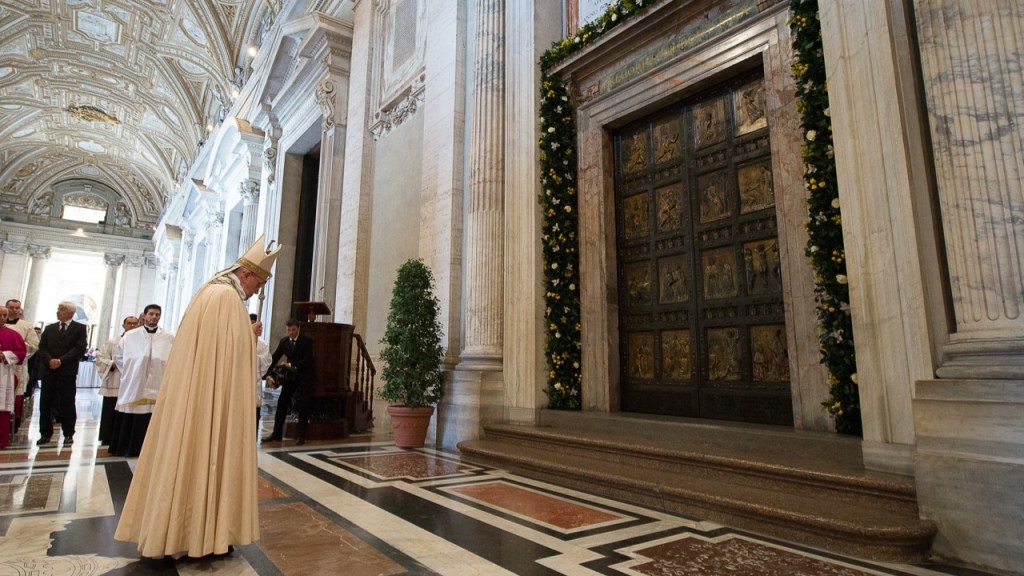
The only quite distinctive pageantry of a Holy Year is associated with the opening and closing of a Holy Door in each of the four Basilicas connected with the Indulgence. It is sometimes thought that the whole idea of the Holy Doors originated with the Jubilee of 1500 in the pontificate of Pope Alexander VI: for the traditional ceremonies now employed in the opening and closing were then composed and have changed little since the sixteenth century. Although no ceremonial forms for the opening and closing of the Holy Doors previous to 1500 have been preserved, it is quite certain that the usage took place in Jubilee Years prior to the sixteenth century; though when they began is uncertain.
Albericus a Rosate who attended the Jubilee of 1350, says that a document came into his hands, for whose authenticity he could not vouch, describing a vision to Pope Clement VI in which a certain venerable personage, holding two keys in his hands, bade the Holy Father “Open the door, and from it send forth a fire by which the whole world may be warmed and enlightened.” The first definite mention of a Holy Door is to be found in the account of a Spaniard, Pero Tafur, about 1457. It is most interesting to find that he connects it with the ancient right of sanctuary which having existed in pre-Christian times on the site of the Lateran was confirmed by Pope Sylvester at the request of Constantine. The privileges of this right of sanctuary were so abused, he goes on, that the door giving access to the spot was walled up and only re-opened every hundred years or at the will of the Sovereign Pontiff. In view of the fact that the door of the Lateran was not prescribed in the Bull of Boniface VIII, it seems unlikely that the Holy Door there was essentially connected with the Jubilee.
On the other hand, several witnesses of the 1450 Jubilee refer to the opening of a Holy Door in the Lateran. One of these, Giovanni Rucellai, a Florentine, speaks of the five doors of the Lateran, “one of which is always walled up except during the Jubilee Year, when it is broken down at Christmas when the Jubilee commences. The devotion which the populace has for the bricks and mortar of which it is composed is such that at the unwalling, the fragments are immediately carried off by the crowd, and the foreigners take them home as so many sacred relics.”
The opening of a Holy Door is a fitting symbolism for the opening of a Holy Year, marking a new way, as it were, for the outpouring of God’s graces. But one can also incorporate the right of sanctuary tradition, for it is in line with other ancient customs. The penitents in the early Church who had fulfilled their time of expiation were led by the Bishop to the door of the Church which at his behest was flung open to receive them. A similar idea is connected with the Portiuncula indulgence at Assisi. So it would seem fitting that those whose temporal punishment has been remitted by the gaining of the Jubilee Indulgence should enter in to the Paradise from which their sins have expelled them.
It is quite clear from all the commemorative medals preserved that the essential ceremonial in connection with the opening and closing of the Holy Doors is the same as has obtained in its main outlines since the sixteenth century. This takes place in St Peter’s before the First Vespers of Christmas; the others are opened by Cardinals, usually high dignitaries of the several Basilicas, at the same time and by a special Pontifical mandate.
We may now describe briefly what traditionally happened in St Peter’s at the opening of the Holy Door. The same ceremony, with modifications, is carried out in the other Basilicas. On the 24th December, before Vespers, the Holy Father, the College of Cardinals, and a great retinue gather in procession to the Sistine Chapel where the Blessed Sacrament is exposed. The Pope here intones the Veni, Creator Spiritus and the procession moves to the Portico or Atrium of St Peter’s. The Holy Door is by the side of the main entrance nearest to the Vatican. All other doors are closed and the Basilica is empty. The Holy Father, descending from the Sedia Gestatoria, advances towards the door and knocks thrice with a silver hammer. He intones the verse Aperite mihi portas justitiae (Open unto me the gates of justice) and the choir replies Ingressus in eas confitebor Domino (When I am entered in I will praise the Lord). Other versicles follow. The Pope returns to his throne and the masons begin the demolition of the wall whilst he sings a prayer which is followed by the Psalm Jubilate Deo omnis Terra. When the demolition is complete, the Penitentiaries, in sacerdotal vestments, wash the head-piece, posts and threshold with holy water. More versicles and responses follow, and then this prayer: “O Lord, Who by Thy servant Moses didst institute for the children of Israel the Jubilee and year of remission, grant through Thy goodness to us, who have the honour to be called Thy servants, to commence happily this present Jubilee, ordained by Thy authority; and in which it has been Thy will to set open to Thy people in a most solemn manner this door through which to enter into Thy temple to offer their prayers in the presence of Thy Divine Majesty; that thereby having obtained plenary and absolute remission of all our sins, we may, at the day of our departure out of this world, be conducted through Thy mercy to the enjoyment of the heavenly glory, through Jesus Christ. Amen.”
When this prayer is ended, a processional Cross is put into the Pope’s right hand and a candle into his left, and, passing through the threshold, he intones the Te Deum. After the threshold, the procession re-forms, takes itself to the High Altar for the First Vespers of the Holy Nativity.
The closing of the Holy Doors takes place after the First Vespers of Christmas in the succeeding year. Three Cardinals are deputed to close the other Holy Doors. The Pope is carried towards the Portico after Vespers and, pausing at the Chapel of the Blessed Sacrament on the way to render thanks, intones the Cumi Jucunditate. The materials for the walling-up are then blessed and the Pope and the Clergy pass through the Holy Door for the last time. The Grand Penitentiary offers a silver-gilt trowel wherewith the Pontiff takes up some mortar and covers the threshold. Medals are thrown therein and three square bricks placed on the mortar. The Penitentiaries lay further bricks and the masons finish the work, after which the Holy Father gives his Blessing and the Te Deum is sung. The Holy Door is sealed with a Cross. Thus the Holy Year is closed and the Jubilee Indulgence terminated.
The distinctive ceremonies of the Holy Year are comprised in the opening and closing of these doors. The Eternal City witnesses many other scenes of pageantry and symbolism during the period: the visits of the Pope to the other Basilicas and to the Scala Santa; solemn canonisations and beatifications, all the great functions of the liturgical year. But none of these belong essentially to the Holy Year and they may be witnessed regularly in the life of the Church. It is therefore a great and singular privilege to witness these events so rare and withal so traditional.
 Jubilee 2025