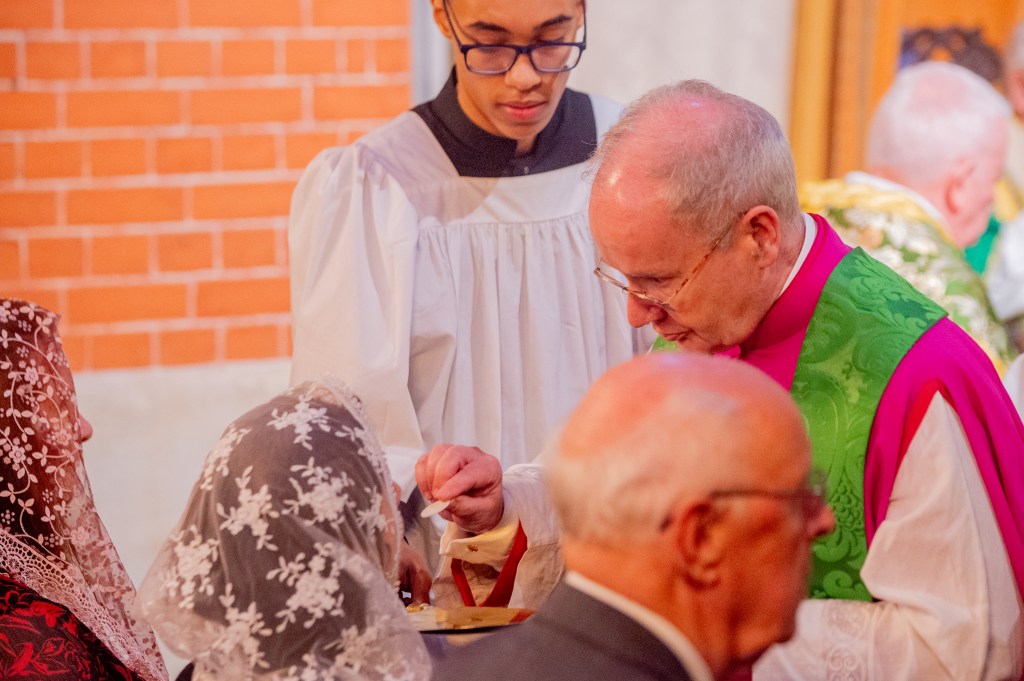
In the most blessed Eucharist is contained the entire spiritual wealth of the Church, namely Christ himself our Pasch and our living bread, who gives life to humanity through his flesh – that flesh which is given life and gives life by the Holy Spirit.
Presbyterorum Ordinis, 5
The Blessed Sacrament is Jesus Christ, Truly Present, Body, Blood, Soul and Divinity under the species of bread and wine. The Catechism of the Catholic Church teaches us that at Mass “we offer to the Father what he has himself given us: the gifts of his creation, bread and wine which, by the power of the Holy Spirit and by the words of Christ, have become the body and blood of Christ. Christ is thus really and mysteriously made present.”
Conditions needed to receive Holy Communion
Be a Catholic in communion with the Holy See of Rome
It sounds obvious, but to receive Holy Communion in a Catholic Church, you need to be ‘in communion’ with the Catholic Church itself. Our Lord Himself desired unity in the Church, and prayed that “they may all be one”. Moreover, many non-Catholic denominations simply do not believe in the Real Presence of Our Lord in the Blessed Sacrament, teaching that it is merely a symbol. In order to fruitfully receive our Lord, you have to have faith and belief in the Eucharist and the Church that He founded. The one exception to this requirement are members of the Orthodox Church “if they seek such on their own and are properly disposed.”
Be in a ‘state of grace’
Because the Eucharist is a sign, symbol, and expression of communion with God, the Church has always taught that a person who is conscious of grave sin should not ordinarily receive the Eucharist without first making a sacramental confession.
Grave sin freely chosen with true freedom – often called mortal sin – “results in the loss of charity and the privation of sanctifying grace, that is, of the state of grace. If it is not redeemed by repentance and God’s forgiveness, it causes exclusion from Christ’s kingdom and the eternal death of hell, for our freedom has the power to make choices for ever, with no turning back,” the Catechism of the Catholic Church says.
“Anyone who is aware of having committed a mortal sin must not receive Holy Communion, even if he experiences deep contrition, without having first received sacramental absolution, unless he has a grave reason for receiving Communion and there is no possibility of going to confession,” the Catechism adds.
St. Paul explains in 1 Corinthians that “whoever…eats the bread or drinks the cup of the Lord in an unworthy manner will be guilty of profaning the body and blood of the Lord. Let a man examine himself, and so eat of the bread and drink of the cup. For any one who eats and drinks without discerning the body eats and drinks judgment upon himself.”
St. Paul’s point is that to receive the Eucharist in a state of grave sin is itself a sin, which fails to respect the holiness of the Eucharistic sacrament, and the integrity of the Church’s communion. The Church tells Catholics not to receive the Eucharist in a state of grave sin not to punish or shame them, but because, if doing so is a sin as Scripture says, it aims to protect Catholics from committing that sin.
In Inferno, the poet Dante Alighieri is believed by some scholars to have included a reference to unworthy reception of Holy Communion, in the tale of Count Ugolino, who is encased in ice in the ninth circle of hell, and found by Dante eating the head of his enemy, an archbishop.
His story alludes to the immoral eating of human flesh, which some scholars believe is a reference to unworthily receiving the Eucharist.
So, in short, it is important to go to Confession before receiving Holy Communion.
Fast for one hour before receiving Holy Communion
From the very earliest time the custom was observed of administering the Eucharist to the faithful who were fasting. Towards the end of the fourth century fasting was prescribed by many Councils for those who were going to celebrate the Eucharistic Sacrifice. So it was that the Council of Hippo in the year 393 issued this decree: ‘The Sacrament of the altar shall be offered only by those who are fasting.’ Shortly afterward, in the year 397, the Third Council of Carthage issued this same command, using the very same words. At the beginning of the fifth century this custom can be called quite common and immemorial. Hence St. Augustine affirms that the Holy Eucharist is always received by people who are fasting and likewise that this custom is observed throughout the entire world.
Doubtless this way of doing things was based upon very serious reasons, among which there can be mentioned first of all the one the Apostle of the Gentiles deplores when he is dealing with the brotherly love-feast of the Christians. Abstinence from food and drink is in accord with that supreme reverence we owe to the supreme majesty of Jesus Christ when we are going to receive Him hidden under the veils of the Eucharist. And moreover, when we receive His precious Body and Blood before we take any food, we show clearly that this is the first and loftiest nourishment by which our soul is fed and its holiness increased. Hence St. Augustine gives this warning: “It has pleased the Holy Spirit that, to honour so great a Sacrament, the Lord’s Body should enter the mouth of the Christian before other food.”
Not only does the Eucharistic fast pay due honour to our Divine Redeemer, it fosters piety also; and hence it can help to increase in us those most salutary fruits of holiness which Christ, the Source and Author of all good, wishes us who are enriched by His Grace to bring forth.
The Church’s law around the Eucharistic Fast is:
- One who is to receive the Most Holy Eucharist is to abstain from any food or drink, with the exception only of water and medicine, for at least the period of one hour before Holy Communion.
- Those who are advanced in age or who suffer from any infirmity, as well as those who take care of them, can receive the Most Holy Eucharist even if they have taken something during the previous hour.
If you are not sure whether you are able to receive Holy Communion or not, please speak to a priest and discuss your situation with him directly.
How to receive Holy Communion
Holy Communion is normally distributed as part of the celebration of Mass, after the priest has received Communion himself. He will then approach the altar rails to distribute Communion to the faithful. The Church provides choices which each recipient is at liberty to make: to receive the Sacred Host on the tongue or in the hand, either kneeling or standing. Each way has its symbolic and spiritual meaning helping us to be profoundly aware of whom it is that we receive and the unity of faith we share.
Kneeling or standing?
The traditional way of receiving Holy Communion in the Latin Church is kneeling, while in the Eastern Rites it is standing. The Church gives you the freedom to choose which suits you best, though sometimes physical difficulties make that choice for us!
When we receive Holy Communion kneeling, we present ourselves with humility and reverence, submitting our strength to Him, recognising that He is Lord of all.
When we receive Holy Communion standing we show that we are ready to receive the Lord and to walk and act in His name. In standing we are part of a prayerful procession, a people with a mission, summoned by the Lord to the glory of heaven.
On the tongue or in the hand?
Traditionally, Holy Communion in the Latin Church is received by the priest placing the Sacred Host directly on your tongue. Similarly, in the Eastern Rites, the priest distributes Holy Communion using a spoon, administering a piece of the Host with some of the Precious Blood directly into your mouth. In England and Wales, as well as some other countries, permission has been granted by the Holy See for Holy Communion to also be distributed in the hand.
When we receive Holy Communion on the tongue, we are aware of coming to be fed with the Food of Life, conscious of our utter dependence on the Lord. We know the holiness of the One we receive, beyond our touch. Tilt your head back slightly, and extend your tongue a little way out of your mouth. This allows the priest to easily place the Host on your tongue, without having to touch your mouth. It is not sufficient to simply open your lips, as the priest cannot ‘post’ the Sacred Host through your teeth as though it were a letter in a postbox.
When receiving Holy Communion in the hand, we make with our hands the form of both a cross and a throne in which to receive our King who sacrificed his life for us. With clean, empty hands and with gloves removed, we receive him with utter reverence and consume the Host carefully in the presence of the minister before turning away. Lay your hands completely flat; do not make a ‘bowl’ with your palms. Put your right hand underneath your left hand. Let the priest lay the Host on your left palm, and then use your right hand to pick it up, and place it directly into your mouth. Do not take the Host out of the priest’s hand yourself. Make sure there are no crumbs left in your palm: each tiny fragment is still Truly our Eucharistic Lord. If there are any crumbs, collect them up with your finger and consume them as you did the Host.
Making a Spiritual Communion
The information below is for those who are unable to receive Holy Communion. A Spiritual Communion, however, does not fulfil the requirements for receiving the Plenary Indulgence.
Spiritual Communion is the heartfelt desire to receive Our Lord, even when we are unable because of the distance or for some other reason. This desire to receive him through spiritual Communion is an act of love which prolongs our thanksgiving even when we are not in the Eucharistic presence of Our Lord. The wish to live constantly in his presence can be fuelled by acts of love and desire to be united with him and is a means of drawing more deeply from the life of the Holy Spirit dwelling within our souls in the state of grace. “The effects of a sacrament can be received by desire. Although in such a case the sacrament is not received physically… nevertheless the actual reception of the sacrament itself brings with it fuller effect than receiving it through desire alone” (St Thomas Aquinas).
Acts of Spiritual Communion
My Jesus, I believe that You are truly present in the Most Holy Sacrament. I love You above all things, and I desire to receive You into my soul. Since I cannot at this moment receive You sacramentally, come at least spiritually into my heart. I embrace You as being already there and unite myself wholly to You. Never permit me to be separated from You. Amen.
St Alphonsus Liguori

