- What is an Indulgence?
- Conditions needed for the Indulgence
- How to gain the Indulgence during a normal year
- How many Indulgences can I get each day?
While the Holy Year of Jubilee has come to an end, it is still possible to obtain Plenary Indulgences during the course of a normal year. In practical terms, the experience of God’s mercy involves some spiritual acts indicated by the Pope.
What is an Indulgence?
In short, a plenary indulgence is a grace granted by the Catholic Church through the merits of Jesus Christ to remove the temporal punishment due to sin.
The indulgence applies to sins already forgiven. A plenary indulgence cleanses the soul as if the person had just been baptized. Plenary indulgences obtained during the Jubilee Year can also be applied to souls in purgatory with the possibility of obtaining two plenary indulgences for the deceased in one day, according to the Apostolic Penitentiary.
A Simple Explanation of Indulgences
It may be useful here to give a simple explanation of the meaning of a doctrine which has been more greatly misunderstood than any other in the Church’s history. Rightly understood, the Church’s teaching about Indulgences opens new vistas of the inestimable mercy of God.
Children by their very nature have an irresistible attraction to throwing stones. Imagine your child goes out into the street and in a vindictive moment, perhaps, hurls a rock through the window of your house. Your anger is righteous: and the boy, partly from fear and partly because he realises that he has done something irreparable, tells you he is sorry and asks your forgiveness. When you have cooled down little you say something like this: “Well, as you are sorry, I will forgive you. But remember the damage is done; and you must pay me £1 a week out of your pocket money for the next two months.” Later on, if you are an indulgent parent, you will put your hand in your pocket and give him perhaps a £5 note towards the fund for the new pane of glass.
It is something like that when we commit sin: for all sin is an offence against God. It is as though we have deliberately broken God’s window, to use a terminology which is not strictly correct, for God is impassable. We say that we are sorry. God, the most loving of all Fathers, at once forgives us: but the damage has been done and reparation must be made.
We owe Him a debt after our sin has been forgiven. The Church has always made this quite clear to her children, and in the early days of her history instituted that canonical penance which had to be completed before the erring member of the fold was restored to full membership of the Church. The debt must be paid either in this life, by acts of penance, suffering and prayer, or in the next, by Purgatorial fire.
But there is another way also. To return to our analogy, like the indulgent parent, God can bestow upon us the wherewithal to pay off part or the whole of what we owe. And that is exactly what happens when we gain an Indulgence. It is a remission of part or the whole of the temporal punishment which remains due to sin after it has been forgiven.
Notice, nobody can possibly gain an Indulgence from God or Church until he has been forgiven by going to Confession.
Notice too that the Church acts in God’s name. All power has been given to her, to Peter and to his successors. When the Pope grants an Indulgence, he is exercising that authority given to him by Our Lord to bind and to loose, and he is applying the great hoards of the inexhaustible merits of Christ and the Saints to us as individuals. We must show ourselves deserving of such untold benefits and that is indicated by our sincerity and zeal in performing those little acts of prayer, or pilgrimage or penance to which the Indulgences are annexed.
The Jubilee Indulgence marks the outpouring of a great stream of remission. In his Bull announcing the Jubilee, Pope Francis writes:
“This experience of full forgiveness cannot fail to open our hearts and minds to the need to forgive others in turn. Forgiveness does not change the past; it cannot change what happened in the past, yet it can allow us to change the future and to live different lives, free of anger, animosity and vindictiveness. Forgiveness makes possible a brighter future, which enables us to look at the past with different eyes, now more serene, albeit still bearing the trace of past tears.” (Spes non Confundit, 23).
Conditions needed for the Indulgence
In order to obtain any of the plenary indulgences listed above, the following conditions must be fulfilled:
- Detachment from all sin, even venial.
- Some pious act must be performed (more details below).
- Sacramental Confession must be made either on the same day as the work is completed or a few days before or afterwards.
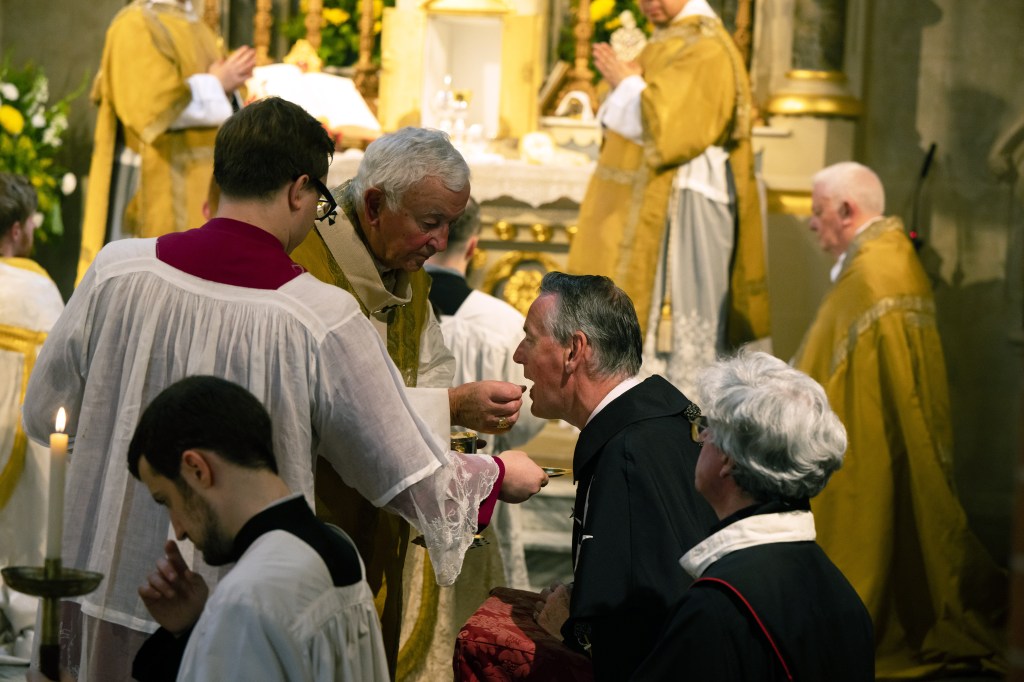
- Holy Communion must be received during the Holy Year.
- Prayers for the intentions of the Pope must be said. While the decree leaves the choice of prayers open, this condition is usually fulfilled by reciting the Our Father, the Hail Mary and the Glory be.
A single sacramental confession is sufficient for several plenary indulgences, but frequent sacramental confession is encouraged in order to obtain the grace of deeper conversion and purity of heart.
For each plenary indulgence that is sought, however, a separate Holy Communion and separate prayers for the intentions of the Holy Father are required.
How to gain the Indulgence during a normal year
- Recite five decades of the Holy Rosary while in a church, in a family, a religious community, or an association of the faithful. There should be no interruption during the recitation.
- Pray the Stations of the Cross here at the Shrine.
- Spend at least 30 minutes in Adoration of the Most Blessed Sacrament.
- Spent at least 30 minutes piously reading Sacred Scripture.
How many Indulgences can I get each day?
Only one plenary indulgence can be obtained per day, either for yourself or for a Holy Soul in Purgatory. It is not possible to obtain an indulgence for another living person.
The three conditions may be fulfilled several days before or after the performance of the prescribed work; it is, however, fitting that Communion be received and the prayer for the intention of the Sovereign Pontiff be said on the same day the work is performed.
Through this double act, a praiseworthy exercise of supernatural charity is carried out, through that bond by which the faithful still journeying on this earth are united in the mystical Body of Christ, with those who have already completed their journey, by virtue of the fact that “the Jubilee indulgence, thanks to the power of prayer, is intended in a particular way for those who have gone before us, so that they may obtain full mercy”.
 Jubilee 2025